Most event planners default to bands, DJs, or keynote speakers. But there's a reason the most memorable events often feature something unexpected — and magic delivers that in a way nothing else can.
Every year, thousands of corporate events are planned with the same formula: a venue, a catered dinner, a band or DJ, maybe a motivational speaker. And every year, attendees walk away having had a perfectly fine evening — one they'll forget by Monday morning.
I'm Kristian Charles, a professional magician based in Cincinnati, Ohio, and I've performed at hundreds of corporate events over the past decade. The feedback I hear most often isn't about the tricks themselves — it's about the conversations that started because of them. Magic is a social catalyst. It gives strangers something to talk about, something to laugh about together, something to share.
Think about the last conference or company party you attended. What do you actually remember? Probably not the keynote. Probably not the buffet. You remember the moment something surprised you — the moment you turned to the person next to you and said, 'Did you just see that?'
That's what magic does. It creates shared moments of genuine wonder. And in a corporate setting, where you're trying to build team cohesion, impress clients, or reward employees, those moments are worth more than any PowerPoint slide.
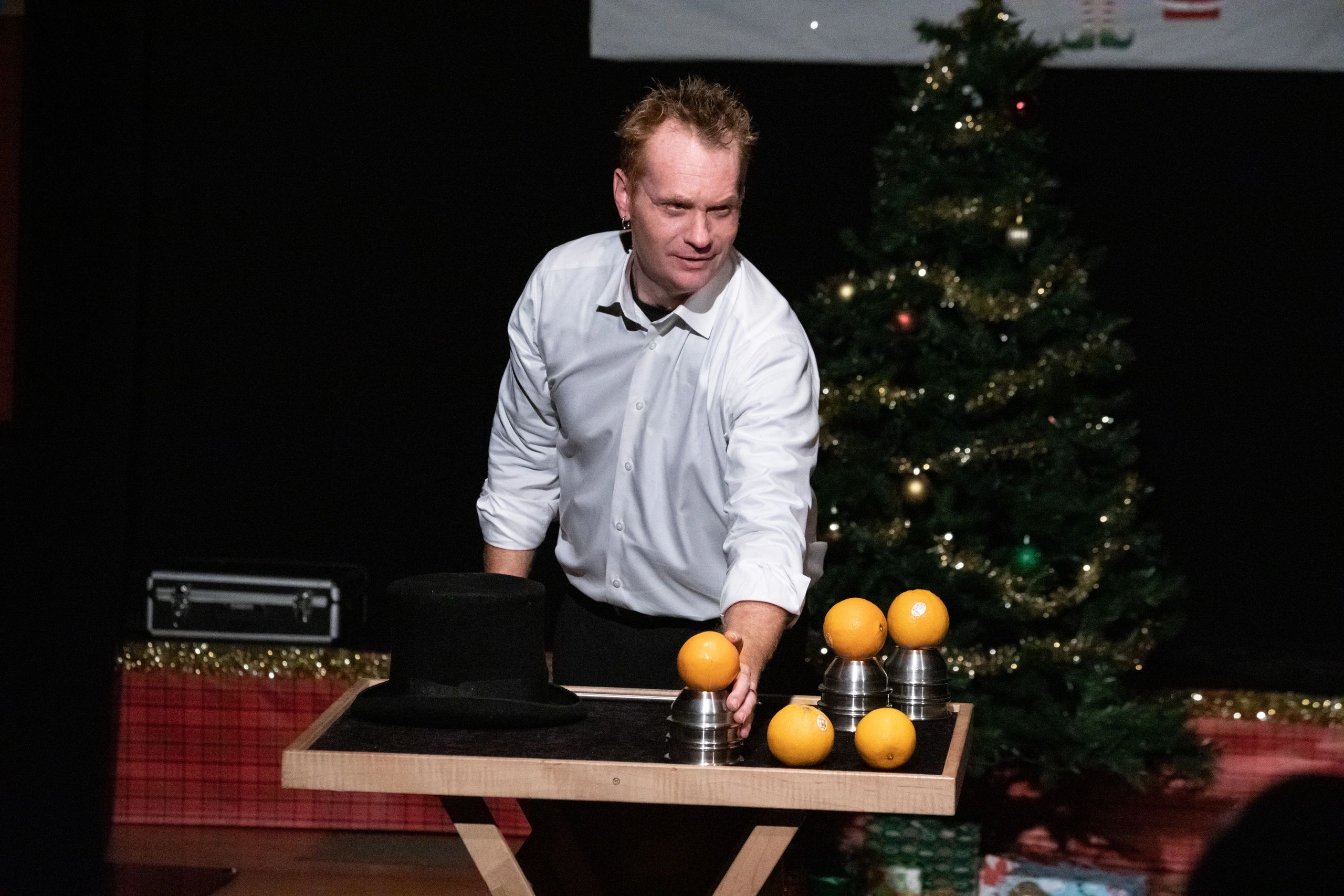
There's also a practical advantage: magic scales. I can work a cocktail hour moving table to table, engaging small groups in intimate, personalized close-up magic. Or I can anchor an awards dinner or product launch with a full theatrical stage show. The format flexes to fit your event — and I customize every performance to fit your company, your culture, and your audience.
The most underrated part? Magic is universally accessible. It doesn't require a shared language, a shared sense of humor, or a shared musical taste. Wonder is a human experience. It works on the CEO and the intern, the client from Tokyo and the vendor from Texas.
If you're planning a corporate event and you want people to actually remember it, consider adding The Kristian Charles Experience to the mix. Not as a novelty — as the centerpiece. Visit kristiancharles.com to learn more or reach out directly to start the conversation.
The corporate holiday party has a reputation problem. Ask most employees what they expect from the annual celebration and you'll hear the same things: awkward small talk, a cash bar, a DJ playing songs nobody requested, and a speech from the CEO that runs ten minutes too long.
It doesn't have to be that way. As a professional magician who has performed at corporate holiday events across Cincinnati and beyond, I've watched what works and what doesn't. Here are five things that consistently transform a forgettable holiday party into something people actually look forward to.
First, anchor the evening with a live experience. A band is fine. A comedian can work. But the most effective anchor is something interactive — something that pulls people out of their phones and into the room. When I perform at a holiday party, I'm not just doing tricks. I'm creating moments that pull the whole room together. When someone's watch disappears and reappears in a sealed envelope, they're not checking their email.
Second, design the flow intentionally. Most parties are structured as a single long block of time with no shape. Instead, think in acts: a cocktail hour with roaming close-up magic, a seated dinner with a focal stage performance, a post-dinner social period with music. Each transition gives people a reason to re-engage.
Third, personalize something. It doesn't have to be elaborate. A custom cocktail named after a company milestone. A slideshow of team photos from the year. A performer — like me — who researches your company and weaves your culture, your wins, and your people into the show. Personalization signals that someone actually thought about the people in the room.
Fourth, give people something to take home — not a branded pen, but a memory. The best party favor is a story. 'You won't believe what happened at the holiday party this year' is worth more than any swag bag.
Fifth, end on a high note. Plan a finale — a closing performance, a toast, a moment that signals the evening is complete. People remember beginnings and endings most vividly. Make the ending count. If you're ready to make this year's holiday party one nobody forgets, I'd love to be part of it. Reach out at kristiancharles.com.
People often assume that a magic show is a magic show — that a performer shows up with a bag of tricks and runs through the same routine they've done a thousand times. For some performers, that might be true. For me — Kristian Charles — it's never been how I work.
Every corporate show I perform starts weeks before the event with a conversation. I want to know about the company: what they do, what they're celebrating, what the culture is like, who will be in the room. I want to know about the event itself: the venue, the format, the flow of the evening, what comes before and after my performance.
That research shapes everything. If a company is celebrating a record-breaking sales year, I might build a routine around numbers and prediction that mirrors their achievement. If it's a product launch, I might incorporate the product itself into a reveal. If the audience is a mix of clients and employees, I'll calibrate the tone differently than if it's an internal team event.
The personalization goes deeper than just name-dropping the company. The best moments are the ones where the audience thinks, 'How did he know that?' — where the magic feels like it was made specifically for them, because it was. That level of customization is a signature of The Kristian Charles Experience, and it's what separates a good show from one people talk about for years.
After the research comes the construction phase. I'm selecting which pieces to include, in what order, and how to connect them. A show has a shape — it builds, it breathes, it has peaks and valleys. Putting the wrong piece in the wrong position can undermine an otherwise strong set.
Then comes rehearsal. Not just running through the mechanics, but rehearsing the words, the timing, the pauses. Comedy and wonder both live in the pause. A beat held one second too long or too short changes everything.
By the time I walk into a venue, I've lived with that show for weeks. I know every moment, every contingency, every way it might go differently than planned — and I've prepared for all of them. The goal is to walk out and make it look effortless, because the audience deserves to experience the wonder without seeing the work behind it. Want to see what a custom show could look like for your event? Visit kristiancharles.com to get started.
There's a moment in every performance I give — you can see it on people's faces — where the brain simply stops. The impossible has happened. The mind knows it can't be real, but the eyes say otherwise, and for just a second, the two are in open conflict.
That moment is what psychologists call cognitive dissonance, and it turns out it's one of the most powerful emotional experiences a human being can have. It's the same mechanism that makes a great plot twist so satisfying, or a surprising piece of news so arresting. The brain loves to be right, and when it's wrong in a delightful way, the response is visceral.
Research on the neuroscience of wonder shows that moments of genuine surprise trigger a release of dopamine — the same neurotransmitter associated with reward, pleasure, and motivation. This is why people laugh when they're fooled by a good trick. It's not embarrassment; it's a neurological reward. As a performer, I'm essentially a dopamine delivery system.
But magic works on a social level too, not just an individual one. When a group of people experiences wonder together, something interesting happens: they bond. Shared surprise creates shared memory, and shared memory creates connection. This is why The Kristian Charles Experience is so effective at corporate events — it gives a room full of people a common experience to talk about, long after the evening ends.
There's also something important about the willing suspension of disbelief. Adults know, intellectually, that magic isn't real. But they choose to engage with it anyway — and that choice is itself meaningful. It's a decision to be present, to be open, to let yourself be surprised. In a world that rewards cynicism, that's a rare and valuable thing.
The best magic doesn't just fool the mind. It moves the heart. The performances I'm most proud of aren't the most technically difficult — they're the ones that made someone tear up, or laugh until they couldn't breathe, or turn to their partner and say something they'd been meaning to say for years.
Wonder is a human experience. It doesn't care how old you are, how sophisticated you are, or how many magic shows you've seen. When the impossible happens right in front of you, something in you responds. That response is what I'm after, every single time. If you'd like to bring that experience to your next event, I'd love to talk — kristiancharles.com.
Choosing entertainment for a gala is one of the most consequential decisions an event planner makes — and one of the most frequently rushed. The venue gets months of attention. The catering gets weeks. The entertainment gets a few phone calls and a YouTube search the month before.
As a professional magician who has performed at galas, award dinners, and fundraisers across Cincinnati and nationally, I've seen this play out more times than I can count. Here's a framework I've found useful — both as a performer and as someone who's watched a lot of events succeed and fail.
Start with your audience, not the act. Who is in the room? What's their age range, their cultural background, their relationship to each other? A comedian who kills at a tech startup might fall flat at a healthcare gala. A band that's perfect for a wedding reception might feel out of place at a black-tie awards dinner. The best entertainment is the entertainment that fits the specific people in the room.
Consider the format of the evening. Is there a seated dinner? A cocktail hour? A post-dinner reception? Different entertainment formats work better at different points. Close-up magic — the kind I specialize in — is ideal for cocktail hours. It's intimate, mobile, and doesn't require everyone to stop and pay attention at once. A stage show works best when you have a captive audience and a clear focal point.
Think about the goal of the event. Is this a client appreciation event? An employee recognition night? A fundraiser? The entertainment should serve the goal. If you're trying to impress clients, you want something polished and memorable. If you're celebrating your team, you want something warm and participatory. The Kristian Charles Experience is designed to do both.
Ask about customization. The best performers don't just show up and run their standard set. When you book me, I learn about your event, your organization, your audience, and I tailor the experience accordingly. That level of personalization is what separates a good performance from a great one.
Finally, trust your instincts about the person, not just the act. You're going to be working with this performer in the weeks leading up to your event. Are they responsive? Do they ask good questions? Do they seem genuinely interested in making your event a success? The best entertainment relationships are collaborations, not transactions. I'd love to start that conversation with you — visit kristiancharles.com to reach out.
I got the call on a Tuesday. Sony Music was hosting a private event in New York, and they wanted a magician. Not a big stage show — something intimate, something that would work in a room full of music industry executives, artists, and their guests. The kind of room where everyone has seen everything and nothing impresses them.
I said yes before I finished reading the email. As a Cincinnati-based performer who has built The Kristian Charles Experience around high-stakes, high-expectation audiences, this was exactly the kind of challenge I live for.
The preparation was different for this one. I knew the audience would be sophisticated, skeptical, and easily bored. These were people who spent their careers in entertainment — they understood performance, they understood craft, and they had zero patience for anything that felt like a gimmick.
So I stripped everything back. No big props, no theatrical patter, no elaborate setups. Just cards, coins, and conversation. The kind of magic that happens six inches from someone's face, where there's nowhere to hide and no room for error.
The first group I approached was a cluster of executives near the bar. I could feel the skepticism from three feet away. I did a single piece — a card routine I've performed thousands of times — and watched the skepticism dissolve in real time. By the end, one of them had grabbed a colleague's arm and was pulling them over to see it again.
That's the thing about reading a room: it's not about adjusting your tricks. It's about adjusting your energy. In a room full of cool, you have to be cooler. You have to earn the reaction rather than ask for it. When you do, the reaction is ten times more powerful.
I performed for about three hours that night, moving through the room, group by group. By the end, I'd performed for people whose music I'd grown up listening to, whose work had shaped my own sense of what performance could be. It was one of those nights that reminds you why you do this. If you want to bring that same energy to your next event — whether it's a corporate dinner in Cincinnati or a private gathering anywhere in the country — I'd love to make it happen. Start at kristiancharles.com.
Kristian Charles
Award-winning magician & entertainer
Ready to experience the magic firsthand?
Reading about it is one thing. Seeing it live is another.